I am one of those people who goes to Louisiana whenever the mood strikes, because I simply like being up there. I read a little beforehand, look at the exhibitions, and post a couple of photos on Instagram so people think I have culture. Often I spend just as long in the museum shop. It is excellent.
One star
Two stars
Three stars
Four stars
Five stars
Disclaimer: Apropos Magazine received access or a review copy. As always, we share our own impressions — unfiltered.
Six stars
But every now and then I walk into an exhibition and forget what else I had planned to do. That was how I felt about Tracey Emin's A Second Life. When I left, three things were still in my head: an unmade bed, an embroidery about abortion, and a photograph of her stomach after cancer surgery. It took me a while to understand what they had to do with one another.
The exhibition is organised by Tate Modern in collaboration with Louisiana and spans around four decades. On one wall hang rows of tiny images in gold frames, surrounded by frayed fabric. My Major Retrospective II 1982-1992 (2008) makes me move right up close to something I would otherwise expect to see on a large scale.
Tracey Emin was born in London in 1963 and grew up in the coastal town of Margate. She broke through in the 1990s as part of the Young British Artists circle. In the film Why I Never Became a Dancer (1995), she tells of being mocked at a dance competition as a teenager. In 2020, she was diagnosed with bladder cancer and underwent major surgery. Both Margate and the changed body keep returning in her work.
In the film, the boys have time to wreck her dancing that night in Margate. When she tells the story again, she names them, and then Sylvester comes in. Now she dances herself in front of the camera. The title says she never became a dancer. That is a little hard to believe when you watch her.
In Louisiana Channel's 52-minute interview I Am Doing What I Think Is Right, Emin begins with an image of herself sleeping on her mother's sofa. She had wanted to paint their faces, she says, but ended up painting a situation in which she could recover the feeling of being cared for. I like that she starts there. You can go into Louisiana and think every reclining body is on the verge of falling apart. In the interview, there is one that can safely fall asleep.
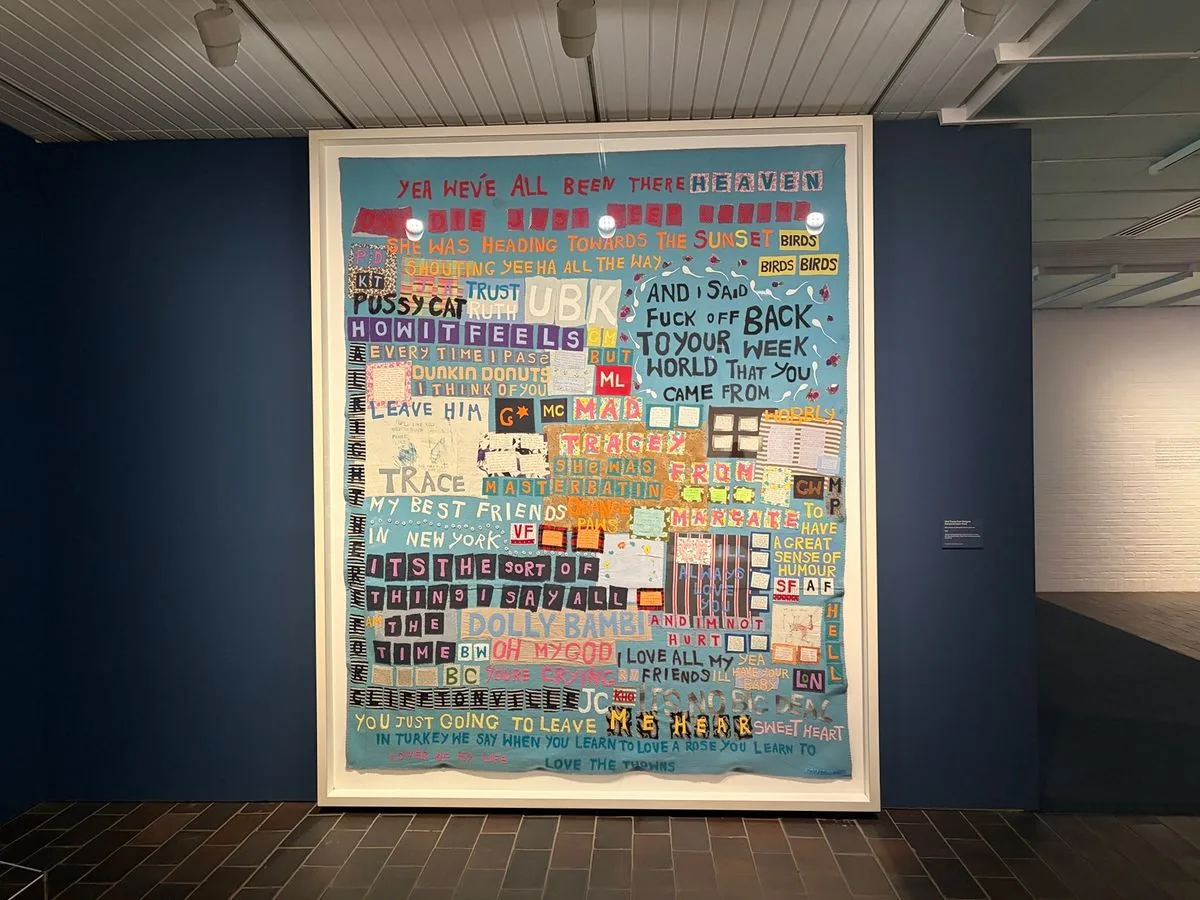
On the turquoise carpet Mad Tracey from Margate. Everyone's been there (1997), the large letters can be read from across the room, while the smaller words make you walk closer. Some of the fabric comes from friends' clothes. That changes what you are actually looking at. She tells her own story through things that have been on other people's bodies. In No chance (WHAT A YEAR) (1999), the floral patches hang beneath a frayed British flag. A correction is sewn in red. Someone sat there with needle and thread and decided the sentence still was not right.
In The Last of the Gold (2002), she uses the alphabet to organise experiences and advice about abortion. From a distance, it looks like something that could hang in a classroom. Then you move closer and find out what is actually being taught. The alphabet makes it look as if somebody has a grip on things. That is rarely the case when you are standing in the middle of it.
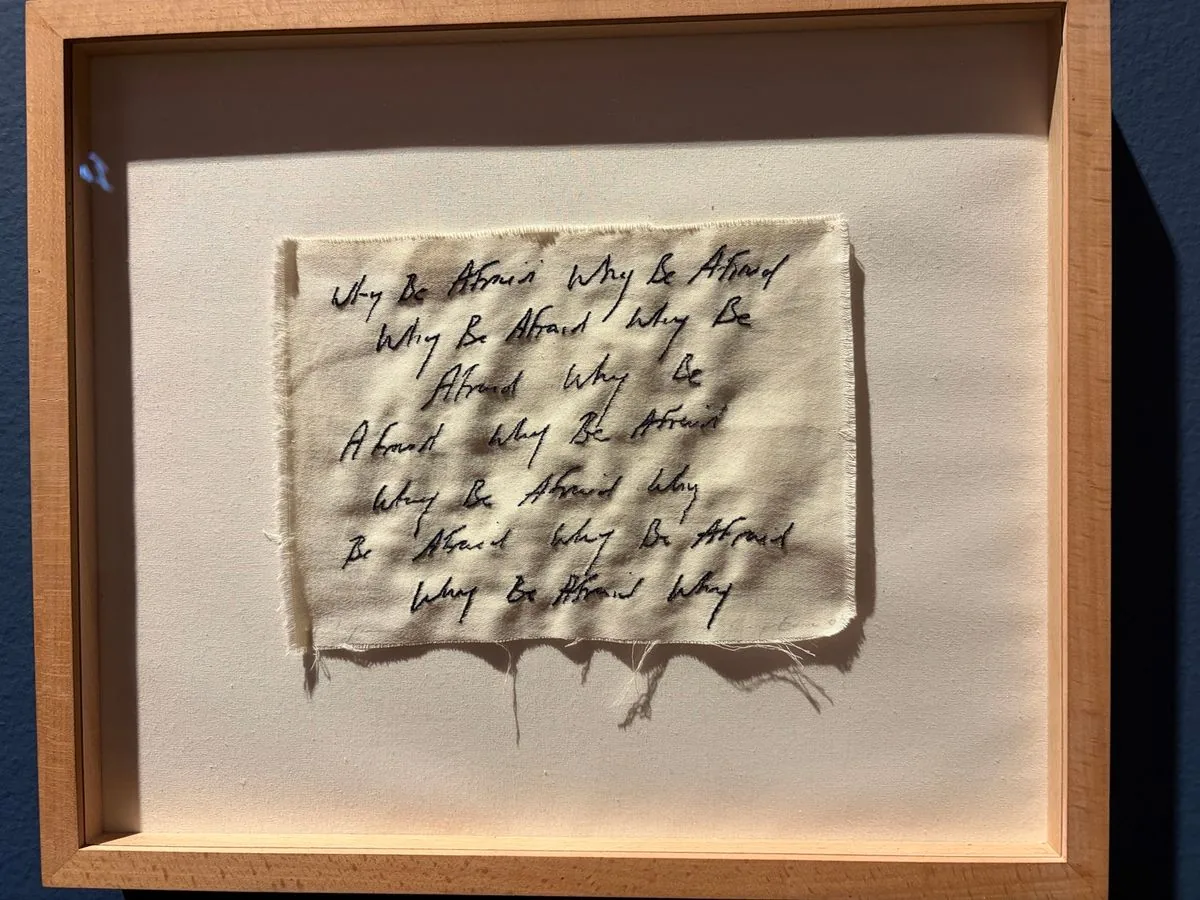
A quarter of an hour into the interview, Emin compares her memory to filing cabinets. She can pull out an experience, work with it, and put it away for years. It sounds almost neat and administrative for an artist who has made an entire public debate out of her bedding. But it fits the small embroidery Why - (2009) very well. She stitches the same question about fear again and again until it is finally interrupted by a solitary Why. You can read it in a few seconds. Try imagining how long it took to sew.
It was You Keep Fucking me (2024) that hit me hardest among the paintings. The words sit at the top of the canvas in different sizes and run across one another. Below them is a dark red blot around the head and so many lines around the body that I cannot get it to stay still. In English, the phrase can be heard both as something sexual and as an accusation. The words keep coming. The body beneath makes it hard to tell what is actually happening.
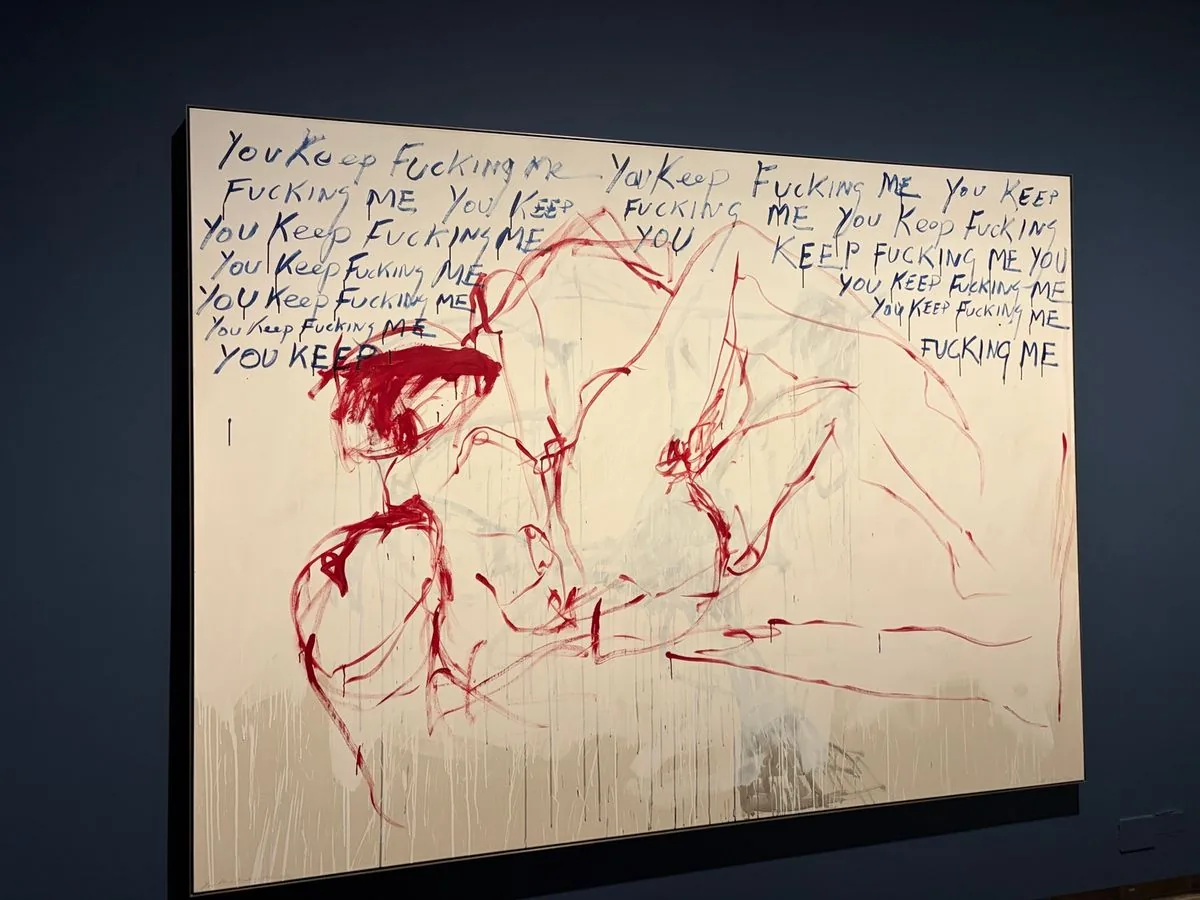
In Rape - (2018), the most direct word appears on the wall label. On the canvas there are red strokes interrupted by a broad, pale field. The title tells me what violence the work circles around, but I still have to look for what the paint does to the body. In the embroidery Keep your Darkness Away (2011), by contrast, I can find the bathtub without effort. The figure on the floor is harder to separate from the dense black stitching. The recognisable bathroom makes the scene feel even more unsettled to me.
In some places I wish the wall texts gave me a little more time. In I needed you to love Me (2023), there is plenty of space above the blue lines around the head and the raised knee. I would have liked a moment alone with the reclining figure before reading the label. It is hard to get your first look back once you know the story. Emin says in the interview that a Rothko painting hit her before she knew anything about his life. I would have liked a little more room for that experience here too.
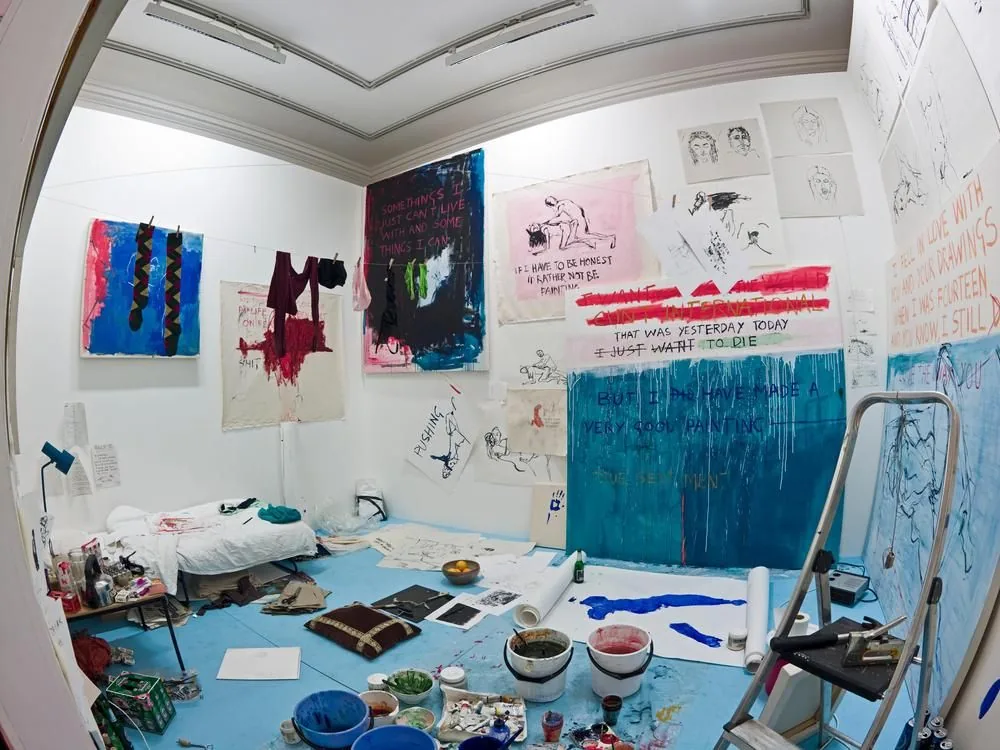
There is beer and an ashtray in the room that looks like a studio. Drawings and desperate messages hang on the walls. Exorcism of the last painting I ever made (1996) grows out of three weeks Emin spent working in isolation in a gallery in Stockholm to find her way back to painting. I could see the room both as an entry point into her work and feel how eager I was to gain access to her mess. That feeling returned in front of My Bed (1998), with the crumpled sheets, bottles, cigarette packs and condoms on and around the blue carpet. Emin was nominated for the Turner Prize in 1999, when the installation was shown. Today the debate over whether an unmade bed can be art feels less interesting than the question the bed still asks me. Why am I standing here looking for a person in the things she has left behind?
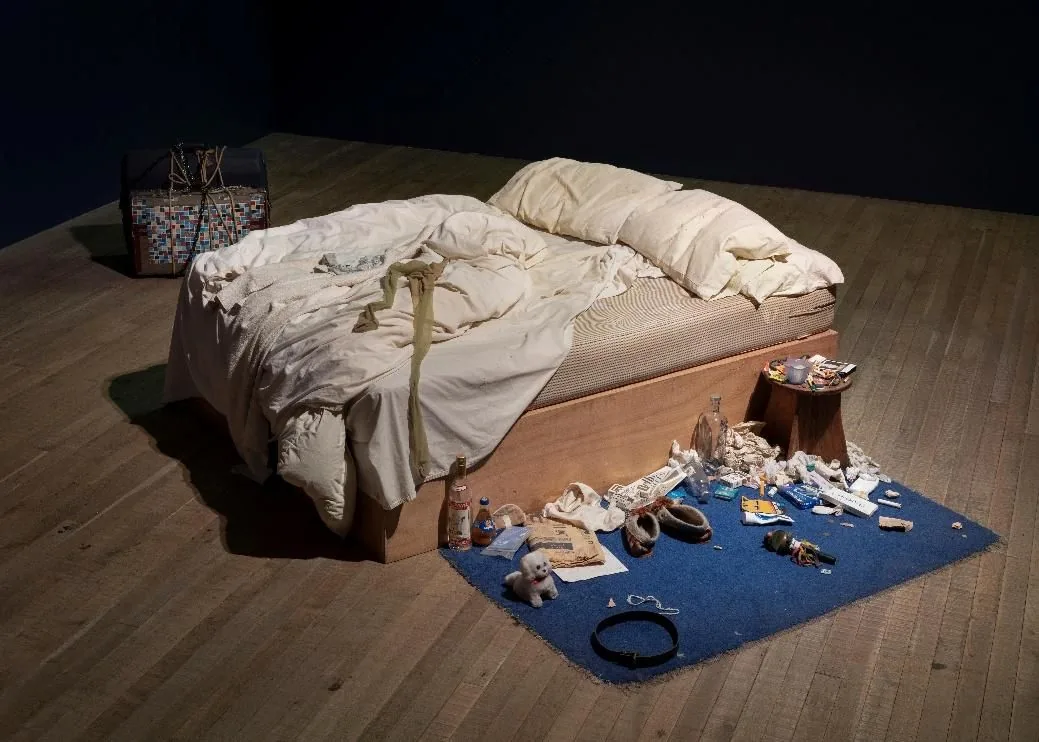
In the interview, Emin recalls how people reacted to My Bed: »People thought it wasn't art.« Later she explains who she first has to be able to answer to for the work: »For me, firstly. And then for others.«
I know that reflex well as a woman: you make the bed before anyone sees it. Or at the very least you apologise for the mess. Emin has put the whole thing in the middle of a museum. And here I am still thinking someone ought to make that bed.
In the display case with the small photographs in Self-portraits - Blood (2020-25), the body becomes visible in a different way. When I saw the red on her stomach, I did not know at first what I was looking at. It is her stoma after surgery for bladder cancer in 2020. I was moved that she had taken the photos herself and chosen to show them. She has been given a body she has to get to know again. And she has brought it into her work, exactly as it looks.
That gaze at the body returns in my review of Lucian Freud at Louisiana.
Let's just put it like this ...
Towards the end of the exhibition, Louisiana shows the bronze Ascension (2024). It is a small, compressed body. After the empty bed and the large paintings, the body suddenly has a size you could almost hold in your hands.
In the interview, Emin says she can paint over the most successful part if it stands in the way of the rest of the picture. When she talks about The Bridge (2024), she describes how she painted in a figure, covered it over, and found it again in another position, on its way up. She herself connects that movement with becoming alive. Towards the end of the conversation, she says that during her illness she feared being remembered as a mediocre 1990s artist. It is a refreshingly concrete ambition amid all the things that might otherwise be allowed to end in neat words about survival. She wanted to live, and she wanted to make better pictures.
I kept thinking about the figure she painted away. On the canvas, Emin can return to something she has experienced and let the body do something else this time. In front of My Bed, I am still standing there looking for her among the things she left behind. She has long since got up.
One star
Two stars
Three stars
Four stars
Five stars
Seks stjerner