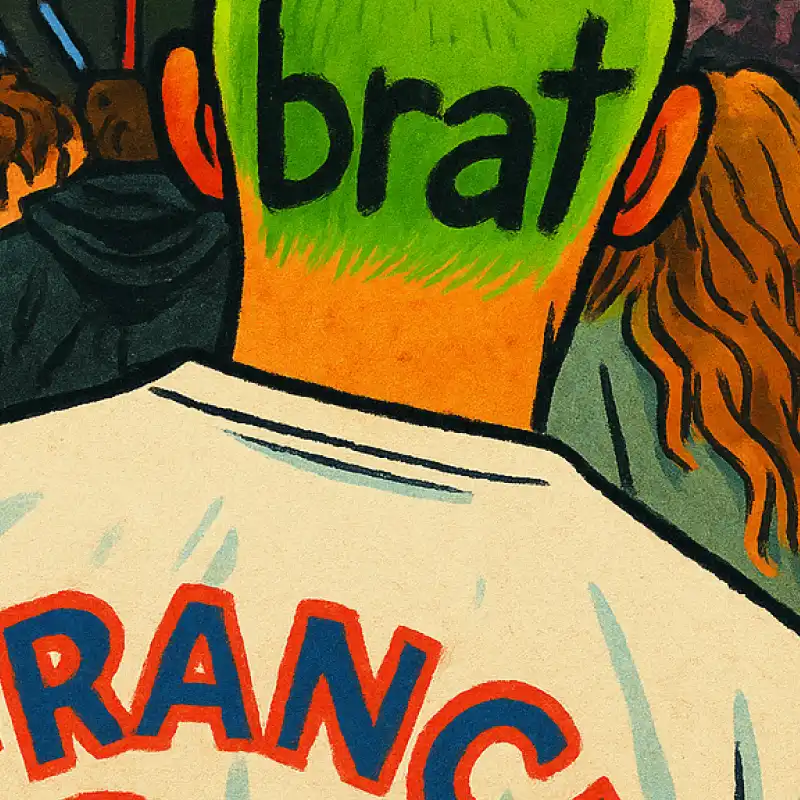
Susan Knorrenborg is the opinion editor at Politiken and made her debut as a novelist with Spørg John in 2024. In They’re Threatening a Party Bus, she sends Lykke into a hen do from hell: she’s getting married in two weeks, has just tried to end a years-long affair, and now her friends are waiting with a party bus full of men from her past. It’s hard to imagine a worse day to be keeping secrets.
One star
Two stars
Three stars
Four stars
Five stars
Disclaimer: Apropos Magazine received access or a review copy. As always, we share our own impressions — unfiltered.
Six stars
There are good friends, and then there are friends who hire a party bus and invite men from your entire love life to your hen do.
It’s a wonderfully cruel premise for a novel. Not because a party bus is especially terrifying in itself — though the combination of Breezers, LED lights and group singing certainly has potential — but because Susan Knorrenborg uses the bus as a machine that slowly strips the protagonist of her right to decide what her own story is.
Lykke is a GP in Brønshøj and is due to marry Jesper. That same morning, she has been to Sweden in an attempt to end her years-long affair with the chef Tom. When she gets home, her friends are waiting with the party. Along the way, former boyfriends and other figures from her past climb aboard with gifts and anecdotes from their shared history. Each new passenger opens another flashback, and very quickly it becomes clear that the Lykke her friends are celebrating is not quite the same Lykke we, as readers, have been allowed to know.
That is the novel’s real engine. Not the question of whether Lykke will be exposed, but who actually has the right to tell a person’s life.
Because Lykke herself is deeply invested in the story of Lykke.
She has divided her life with almost impressive discipline. Jesper belongs in one compartment. Tom in another. Her friends get certain versions. Her family gets others. Old boyfriends remember things she has edited differently herself. And because the novel is narrated by Lykke, we are constantly close to her explanations, her excuses and her tiny internal revisions of reality.
This is where Knorrenborg’s narrative voice really comes into its own.
Lykke doesn’t just lie to other people. She is also excellent at phrasing her own motives in a way that almost makes them sound reasonable. A decision becomes a circumstance. A lie becomes consideration. A double life becomes something that, mysteriously, has simply grown up around her.
You want to hug her and confiscate her phone at the same time.
Happily, Knorrenborg does not turn Lykke into a moral spreadsheet, where infidelity automatically means minus a hundred points and bad person. The novel is far more interested in the small shifts that make it possible for a person to act against their own idea of themselves.
Lykke is a doctor, and that is no accident. She is trained to observe, diagnose and imagine consequences. A tiny detail can grow into a catastrophe in her mind. Professionally, she fears missing something crucial. Privately, she misses, with great energy, the things that don’t fit the version of life she has decided on.
That gives her first-person voice a pleasing doubleness: she is both a sharp observer and someone whose gaze cannot always be trusted.
The novel’s structure also works with that uncertainty. The party bus’s gifts function as little doors into the past. A shirt, a handball, a relationship or an old story first seems like a harmless party anecdote, but takes on a different meaning when Lykke tells her version. The white shirt is especially effective, because it shows how one object can belong to several people’s entirely different memories.
It’s really a simple point: we often say, “Do you remember when…?” as if memory were something you shared.

Of course, it isn’t.
Knorrenborg is at her best when she lets concrete things carry the meaning. Jesper’s crooked terrace is another good example. He builds it for the wedding, and it slopes toward the house. It’s hard not to see it as an image of the relationship: homemade, imprecise, built in good faith and still something you can actually stand on.
That is far more interesting than the hunting lodge’s secret romance with Tom.
Because the affair with Tom thrives precisely on not having to support an everyday life. It exists in a bounded space where bills, illness, washing up and bad terraces don’t really get in. Lykke can tell herself that Tom doesn’t want more. But gradually it becomes less clear whether that is true, or just the story she needs.
The novel is good at those places where responsibility shifts back and forth between people. Tom is not innocent. Jesper is not just the perfect wronged man. The friends are not a Greek chorus meant to explain to the reader what one ought to think morally. Annika in particular can both protect Lykke and tell her she has behaved appallingly.
It’s a more interesting idea of friendship than the notion that loyalty means unconditional support.
Sometimes the most loving sentence is still: I’m staying, but that was absolute shit.
The humour helps a great deal. Knorrenborg is funniest when it comes out of people’s behaviour rather than from constructed punchlines. Lykke’s father can ruin both a sauce and the mood. An asset division becomes so petty that a cookbook almost seems to suffer physically for it. Small objects and embarrassing human actions are allowed to reveal character.
It’s a humour that makes them more human, not less.
And that is why it also matters when the novel occasionally loses faith in its own scenes.
There are passages about gender, diagnoses, relationships and infidelity where the text explains a point I already felt the novel had shown more effectively. The same goes for parts of the middle section. The bus structure is elegant, but each new man offers the chance of another long flashback, and at some point the party bus takes so many detours into Lykke’s youth that you start wishing for a driver with proper rest-time regulations.
It’s not that the digressions are irrelevant. On the contrary, they build the Lykke that the ending can later tear apart. But some of them could be shorter.
The same goes for Annika, who at times becomes a little too useful as the character who can articulate the moral nuance the novel is otherwise so good at showing. When the book trusts the objects, the conflicts and Lykke’s contradictions, it is better than when someone is assigned the job of summing up the point.
On the other hand, Knorrenborg holds on to something crucial right to the end: Lykke is not reduced to her worst action.

That does not mean she is acquitted.
That is an important difference.
The novel could all along have ended in the kind of catharsis where the truth comes out, everyone shouts, someone cries, and the reader can afterwards tick the moral box in the correct column. Neither Lykke nor we get off that easily.
The consequences arrive unevenly. Some people know one thing, others something else. Suspicion turns out not to be the same as knowledge. Love also does not automatically turn out to be forgiveness. The ending leaves the relationships open in a way that suits the rest of the book: no one gets a monopoly on what the story means.
And there, De truer med en partybus reveals itself to be about something a little bigger than infidelity.
It is about our urge to be editors of our own lives.
We all produce an authorised version. The one for colleagues. The one for family. The one for friends. The one for the person we love. And perhaps especially the version we ourselves can bear to live with.
Lykke is simply unusually ambitious in the discipline.
Let’s put it like this…
De truer med en partybus is very funny, but its best quality is that the humour never gets to wash Lykke clean of responsibility. Knorrenborg makes her understandable without making her innocent, while also allowing the people she has hurt to be more than props in her coming-of-age story.
That is exactly why the novel lingers a little longer than the first, very funny idea of a hen do from hell.
Because perhaps the most uncomfortable thing is not having your past gathered into a party bus.
It is discovering that the others can remember it too.
Read Apropos Magazine’s review here (5/6 stars).
En stjerne
To stjerner
Tre stjerner
Fire stjerner
Fem stjerner
Seks stjerner