Lizzie Borden was acquitted of murdering her father and stepmother in 1893, and the case remains unsolved. Netflix has fewer qualms. In Monster: The Lizzie Borden Story, she is turned into victim, avenger, and feminist icon all at once. It’s entertaining. It’s also a little too easy.
One star
Two stars
Three stars
Four stars
Five stars
Disclaimer: Apropos Magazine received access or a review copy. As always, we share our own impressions — unfiltered.
Six stars
Lizzie Borden was acquitted in 1893.
That’s actually quite important to remember, because Monster: The Lizzie Borden Story spends most of its time behaving as if the case has already been settled, the motive understood, and the psychology neatly packed away in a dark velvet box.
The short version is simple enough: Andrew and Abby Borden were found brutally murdered in the family home in Massachusetts. Lizzie was charged. Lizzie was acquitted. And more than 130 years later, no one knows for sure who did it.
The Netflix series has fewer reservations.
Here, Lizzie, played by Ella Beatty, becomes an oppressed young woman trapped in a claustrophobic home where violence, sexuality, and control are slowly compressed until, naturally, someone finds an axe. The series is not especially interested in being a crime puzzle. It would rather be a bloody story about female rage.
And for a while, that actually works.
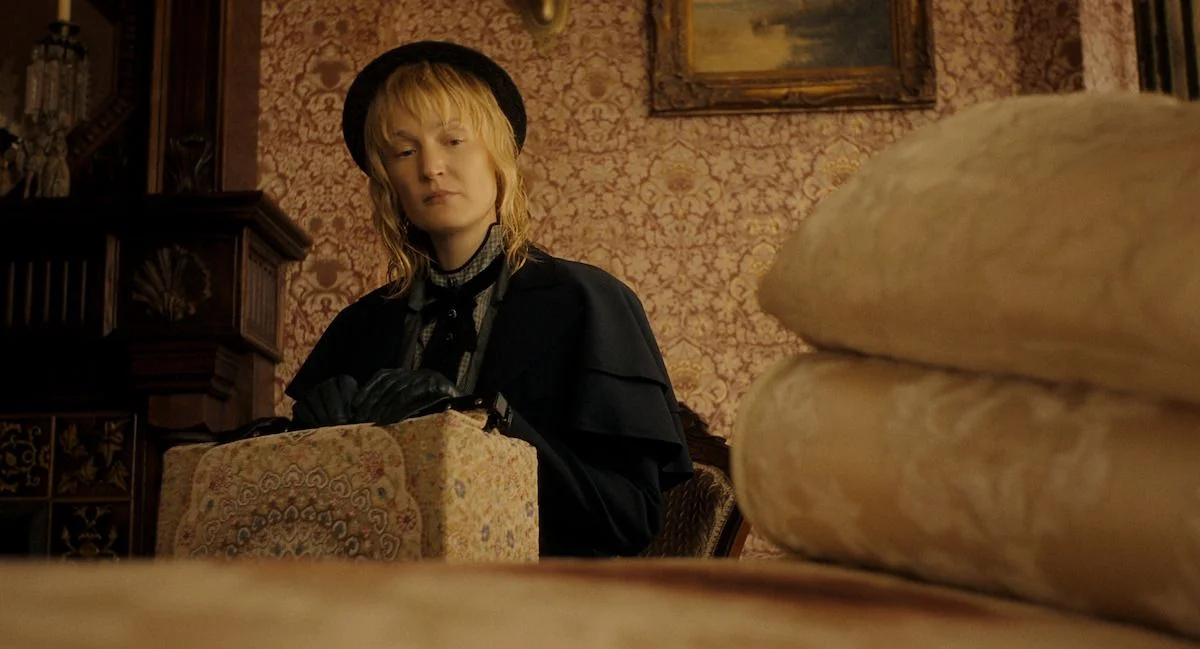
Because the house is the series’ best idea. It feels less like a home than a pressure cooker with curtains. Charlie Hunnam and Rebecca Hall play Andrew and Abby Borden, while Vicky Krieps is the housekeeper Bridget “Maggie” Sullivan. Everyone moves through rooms where glances, money, gender, and hierarchy have already decided who gets to take up space.
That gives Lizzie something more interesting to push against than just a pair of stern parents. The series makes her anger physical. It lives in the clothes, in the rooms, in the bodies, and in the way she is constantly being looked at.
The problem is that Monster very quickly falls in love with its own explanation.
If reality is murky, the series shifts it a little. If the timeline is awkward, it shifts that too. If a relationship could make the theme clearer, it is allowed to appear long before it historically did.
Maggie, for example, becomes far more central to the series’ version of the murders than the historical record can support. The story of Lizzie burning bloodstained clothes is treated with greater certainty, and the attempt to buy prussic acid is expanded into a much more concrete part of her dark development.
Fiction is, of course, allowed to invent. Otherwise we’d only have documentaries, footnotes, and very long evenings.
But there is a difference between using the blank spaces in history and painting them so heavily that you later forget the paper was blank to begin with.
That happens more than once here.
Nance O’Neil is pulled into the story during the trial, even though her documented friendship with Lizzie only began more than a decade later. Sarah Paulson appears as Aileen Wuornos in a thread meant to connect Lizzie to a larger story about women, violence, and the way society turns them into monsters.
Paulson is always hard to resent. She could probably read a municipal parking notice and make it feel like the beginning of a trauma.
But her presence also makes the series’ urge to explain itself very clear. Lizzie is not allowed to be just Lizzie. She has to become the foremother of an entire story about female violence, shame, desire, and liberation.
That’s big.
Sometimes too big.

And that’s a shame, really, because the real Lizzie Borden is already interesting enough.
She was acquitted. She never really escaped suspicion anyway. She ended up as murder mystery, pop-culture icon, feminist figure, and macabre nursery rhyme all at once. There is something far more unsettling in the fact that we still don’t know who she was in relation to the crime.
The series wants to give her a motive so badly that the mystery slowly shrinks.
That doesn’t mean its feminist reading is uninteresting. Quite the opposite. The question of how violent women are interpreted differently from violent men is worth asking. Female rage is still much more quickly turned into diagnosis, sensation, or symbol.
But an interpretation grows stronger when it can withstand reality not quite cooperating.
Here, Lizzie sometimes becomes less a person and more an argument.
That’s where the axe lands a little off.
A conclusion without a conclusion
Monster: The Lizzie Borden Story is handsome, dark, and entirely uninterested in being subtle. When it works, it feels like gothic true crime with enough temperament to bring a 130-year-old case back to life.
But the series wants so badly to know who Lizzie Borden was that it forgets the most fascinating thing about her may be precisely that we still don’t.
Read Apropos Magazine’s review here (3/6 stars).
En stjerne
To stjerner
Tre stjerner
Fire stjerner
Fem stjerner
Seks stjerner