It’s easy to call yourself inclusive when no one has yet asked you to move the furniture. Starting from the documentary All of God’s Colors and the work of Enghave Church, we ask who gets to shape a religious community — not just step inside it.
One star
Two stars
Three stars
Four stars
Five stars
Disclaimer: Apropos Magazine received access or a review copy. As always, we share our own impressions — unfiltered.
Six stars
Everyone is welcome. It’s a sentence almost no institution struggles to write. The hard part comes afterwards: What do you do when the people you’ve invited also want to change something? Choose a different song. Bring their family along. Fill the room in a way that doesn’t look like the people who usually get to decide.
That question is the starting point for this culture feature on All of God’s Colors and the community the film circles around. The text is based on the film’s official description and Enghave Church’s own information. It is a reflection on faith and belonging, not a review of the film’s scenes or craft.
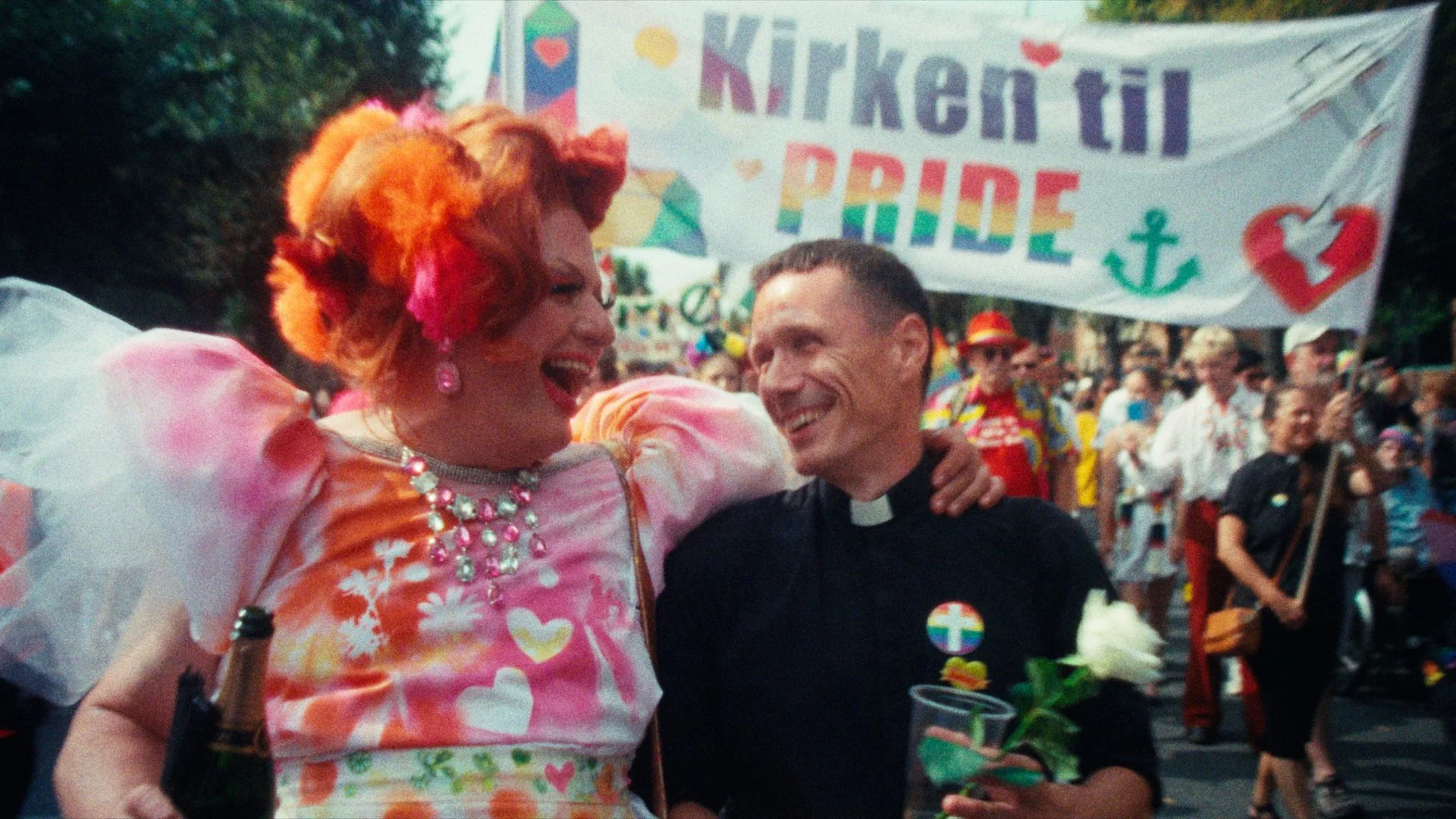
In Jannik Splidsboel’s documentary, priest Viggo Julsgaard Jensen and church caretaker Bo Hagen Clausen, also known through the drag persona Ramona Macho, are the central figures. Distributor Øst for Paradis describes their work at Enghave Church as a struggle for an open church community, told through music, rituals and everyday life. The description also highlights the resistance the church meets from conservative voices.
Belonging is more than getting a chair
It’s worth making the space concrete. Enghave Church itself states that it hosts, among other things, the Danish HIV congregation and holds music services with Ramona and the Youth Choir. It’s not only a question of who is allowed to sit on the pews. It’s also about who becomes part of the church’s programme and gets to give the community a voice.
For me, that is the difference between being tolerated and belonging. A guest is offered a chair in a room others have arranged. A member can help move it. The difference may seem small until you realise that your presence is only valued as long as it doesn’t change anything.
That’s why the practical side of inclusivity interests me more than the grand declarations. Who is on the programme? Who is asked? Which experiences are considered self-evident enough to be given space without first having to justify themselves? A community’s values also reveal themselves in decisions like these.

Ramona doesn’t have to be the opposite of Bo
There’s an easy story one could tell about the church caretaker and the drag persona: the sober everyday person on one side, the colours and liberation on the other. I think that division is too convenient. It risks turning drag into a surprise that the ordinary person has to explain.
The more interesting question is why one role should exclude another. A person can carry responsibility in a church and still have a stage presence. That is not, in itself, a mystery. The mystery is rather our urge to decide which version is the real one before we are willing to take both seriously.
Nor is there any need to turn Ramona into a symbol of everyone else’s freedom. That is a heavy task to place on a person’s work and performance. The right to belong must also include the right not to constantly serve as an educational example for those who already feel at home.

An open door doesn’t solve every conflict
The film’s official description sets the church’s ambition for openness against the resistance it encounters. That points to an important distinction: disagreement about how an institution should function is not the same as rejecting the people who use it. A community can debate its rituals without making anyone’s right to be there an endlessly open question.
Conversely, a church does not become inclusive once and for all because it has found a powerful story about itself. It has to keep making room. Also for the person who is not outgoing, who doesn’t want to be on a stage and who has no desire to explain their identity in front of an audience.
Enghave Church also cannot stand as proof of how the entire Church of Denmark works. One place tells us something about possibilities, not everything about reality. That doesn’t make the example less interesting. It just makes it more precise.
What I take from the film’s subject, then, is not a simple recipe for acceptance. It is a more difficult commitment: A community must be able to let itself be changed by the people it invites in. Otherwise, welcome becomes an agreement that new people may come, as long as everything stays exactly as it was.
The crucial question is not only whether the door is open. It is who is still expected to leave part of themselves behind before they walk through it.
About the film and where to watch it
All of God’s Colors is a Danish documentary from 2026, directed by Jannik Splidsboel. It runs 78 minutes and had its Danish theatrical premiere on 10 September 2026.
See cinemas and find screenings via distributor Øst for Paradis.
En stjerne
To stjerner
Tre stjerner
Fire stjerner
Fem stjerner
Seks stjerner