I’d honestly written off the entire Alien franchise a long time ago. It’s hard not to lose faith when something you love is picked at again and again, like an old wound that never gets to heal. But Alien: Earth does something I didn’t think was possible: it makes me believe in the darkness again.
One star
Two stars
Three stars
Four stars
Five stars
Disclaimer: Apropos Magazine received access or a review copy. As always, we share our own impressions — unfiltered.
Six stars
The Alien universe is one of the few film franchises where even the bad chapters still have teeth. Ridley Scott’s original from 1979 was icy, groundbreaking, impossible to shake. James Cameron’s sequel in ’86 was perhaps less subtle, but effective in its own high-octane way. After that, it started to crumble. Alien 3 was David Fincher’s vision, strangled by studio interference. Resurrection was… something involving clones and French camera movements. And then came Alien vs. Predator, which felt like watching someone use your childhood memories as coasters.
Later we got Prometheus and Covenant. Ambitious, but divisive. Personally, I think Prometheus was beautiful sci-fi with an identity crisis. It tried to be both philosophical and gory — and got a little lost along the way. But at least it tried something. The same goes for Covenant. And now we have Alien: Earth — a new attempt in series form. The biggest surprise may be that it actually works.
From the first episode, you can feel it: real thought has gone into this. The atmosphere is dense, dark, and full of that old paranoia. It feels like Alien, not just something trying to look like Alien. The series dares to be slow. It dares to let silence do the talking. And most importantly: it dares to take itself seriously without becoming self-important.
You quickly sense that we’re back in a universe where actions have consequences. Where death isn’t a cheap plot device, but a real risk. The series moves between the creeping and the explosive. It chooses the former most often, and that suits it. This isn’t about jump scares or blood spray — it’s about sitting there with a knot in your stomach, waiting for something to move in the dark.
But the pace can also create problems. Some episodes feel like they build and build without ever paying off. As if you’re always standing right on the edge of the abyss — without being pushed. That can be frustrating, especially when you’re expecting a payoff as a viewer. Sometimes the show lacks that final bit of pressure, that sense of the screw turning one more notch. Instead, it lets the fear simmer. Most of the time, it works. But not always.
Still, there is one clear high point: the episode “In space, no one…” — an episode that on its own justifies the entire series. It distills everything that makes the Alien universe special: the claustrophobia, the sounds, the darkness, the silence. There is almost something poetic about it. Here, the series becomes more than just an attempt at revival — it becomes a statement. It’s the best thing we’ve gotten from the franchise since Aliens. No doubt about it.

The acting is one of the series’ greatest strengths. Timothy Olyphant seems made for roles with authority, and he uses his presence wisely. He never overplays it. He lets the gaze and the pauses do the work. Babou Ceesay is one of the most underrated actors around right now, and here he finally gets room to breathe. He balances rational decisiveness with emotional depth in a way that gives his character a rare credibility.
And then there’s Sydney Chandler. I didn’t know who she was before I watched this series, but she is its pulse. There’s an energy and a nerve in her performance that make her impossible to ignore. She isn’t just “the young one”; she’s a catalyst for big emotions — fear, anger, care — all with very little. The series would be poorer without her.
Another thing that really works is the use of effects — or rather: the way they aren’t used. We’re used to sci-fi meaning CGI overload and spectacle for spectacle’s sake. Alien: Earth goes the other way. Here, CGI is used sparingly and thoughtfully. It’s practical, ugly, and real. The light flickers. The walls are damp. You can feel the place. And the Xenomorph? It’s back the way it should be: terrifying, unpredictable, and best when you can barely see it.
It feels as if the series has understood one crucial thing: what we don’t see is often the most frightening thing of all. And that’s where it earns its respect. It insists that horror isn’t about shocks — it’s about atmosphere.
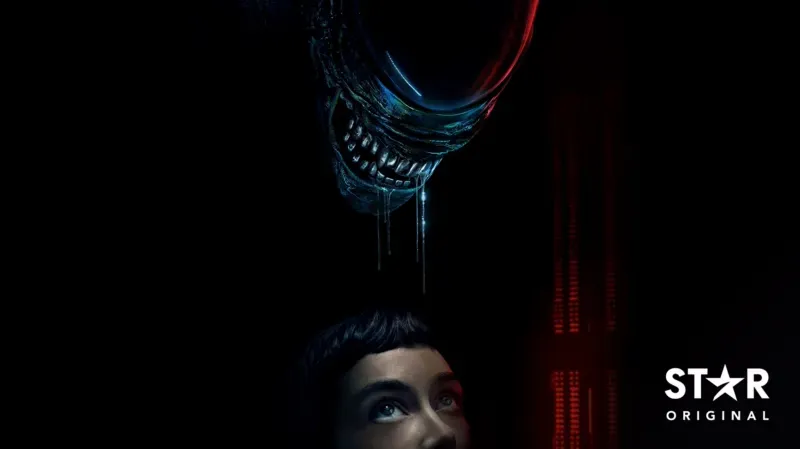
If there’s a real criticism, beyond the pacing, it’s that Alien: Earth feels like the beginning of something bigger. That’s not necessarily a bad thing, but it leaves us with the sense that we’ve only seen the first act. The series holds back — perhaps a little too much. We’re left waiting for season 2 to get answers. That’s frustrating. Because when something is this good, you want more. Now.
But that doesn’t change the overall impression. Alien: Earth is the year’s biggest sci-fi surprise. It feels like a loving, uncompromising reunion with a universe many had given up on. It dares to stay true to the original material while introducing new perspectives. It balances the old and the new — without trying to please anyone unnecessarily. And that may be the best thing you can say about it.
Let’s put it like this:
This isn’t just another streaming series. It’s a serious genre production that knows what it wants — and dares to stick with it. If the rest of the series follows the same course, we may finally have a new chapter in Alien history that can stand alongside the old ones. A rarity in a franchise that has otherwise been more dead than alive.
En stjerne
To stjerner
Tre stjerner
Fire stjerner
Fem stjerner
Seks stjerner