Spotify has started tagging AI-made artists that look like real people but aren’t. At the same time, Suno has launched v6, where an AI song can be edited almost like a piece of studio work. It sounds like two tech stories. In reality, both are about something far more human: Who made the music we hear?
One star
Two stars
Three stars
Four stars
Five stars
Disclaimer: Apropos Magazine received access or a review copy. As always, we share our own impressions — unfiltered.
Six stars
It has become surprisingly hard to answer a very old question:
Who actually made this song?
Spotify has started adding an AI Persona label to artist profiles whose public identity is a photorealistic AI-created person. At the same time, Suno has launched v6, a new generation of AI music tools where you no longer just ask for “a sad pop song” and hope for the best. You can edit individual parts, move vocals around, change lines of lyrics, blend sources, and shape the result far more precisely.
The two things are not directly connected. Spotify and Suno have not launched one shared system. But they approach the same problem from opposite sides: When an artist can be artificial, and a song can be half human, half model, and three prompts on top, what exactly should we be told before we hit play?
Spotify’s new label is an attempt to clean up the first part.
If an artist profile looks like a human being, but the person does not exist, Spotify can now mark the profile as an AI Persona. That can happen either because the artist says so themselves, or because Spotify, after reviewing it, decides the profile presents an AI-generated, photorealistic identity as if it were a real person.
That is, in fact, pretty reasonable.
If I follow a singer because I think she is a human being with a life, a face and a story, it is not a trivial detail if she is actually an image model with a Spotify login.
But the label only tells us who we are looking at.
Not who made the music.
According to Spotify, an AI Persona can release music that is fully human-made, fully AI-generated, or a mix of both. It is almost comically modern: we now have ID cards for faces, but still not necessarily any particularly good explanation of what happened in the studio.
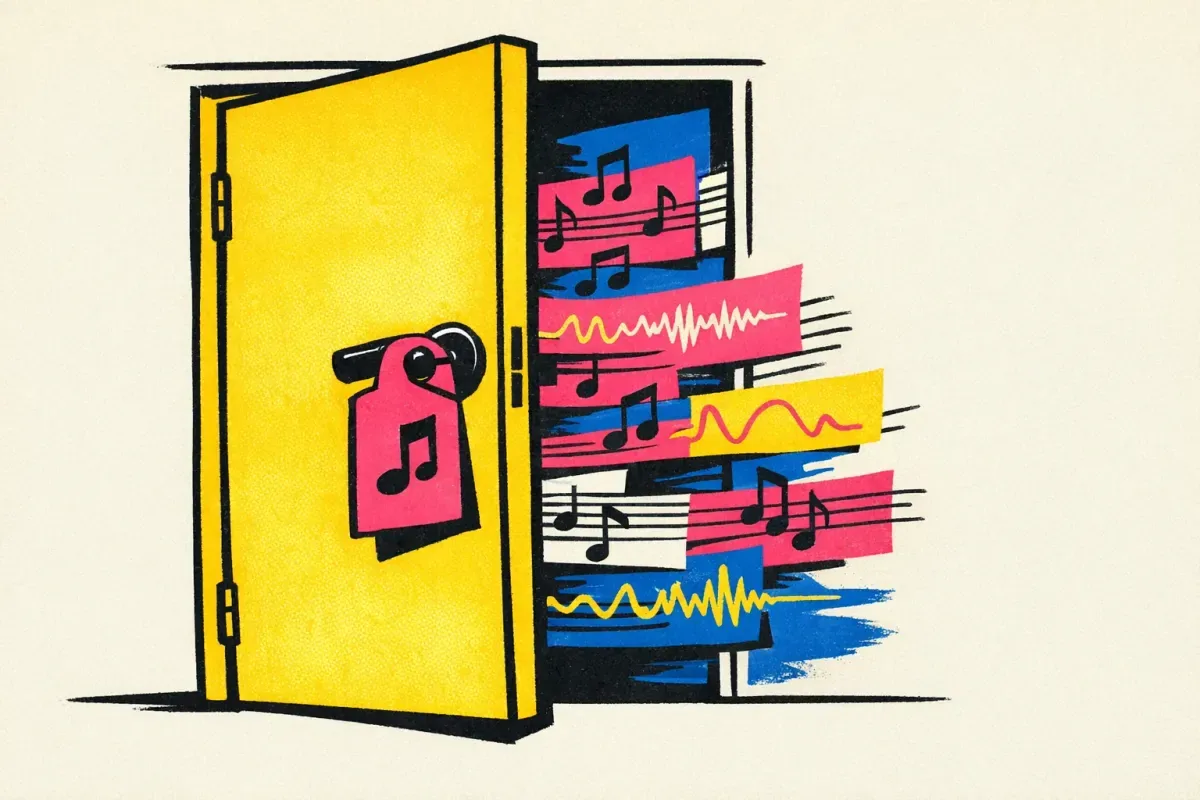
Spotify also has AI Credits. Here, artists can state whether AI was used for things like lyrics, vocals, instrumentation or production. The feature is still in beta and relies on information submitted through participating distributors.
That is an important detail.
Missing AI credit does not mean the song is necessarily AI-free. It only means no credit has been listed.
So we are already in a strange place: the platform can be fairly sure that a face does not exist, but much less sure how much of a song does.
And then Suno v6 enters from the side and makes the question even messier.
Early AI music tools were easy to caricature. You typed something like “make a Danish radio song about divorce with acoustic guitar,” pressed a button, and got a track back. The creativity, of course, still lived in the choices before and after, but the division of labour was easy to understand: the human asked. The machine made.
V6 muddies that division.
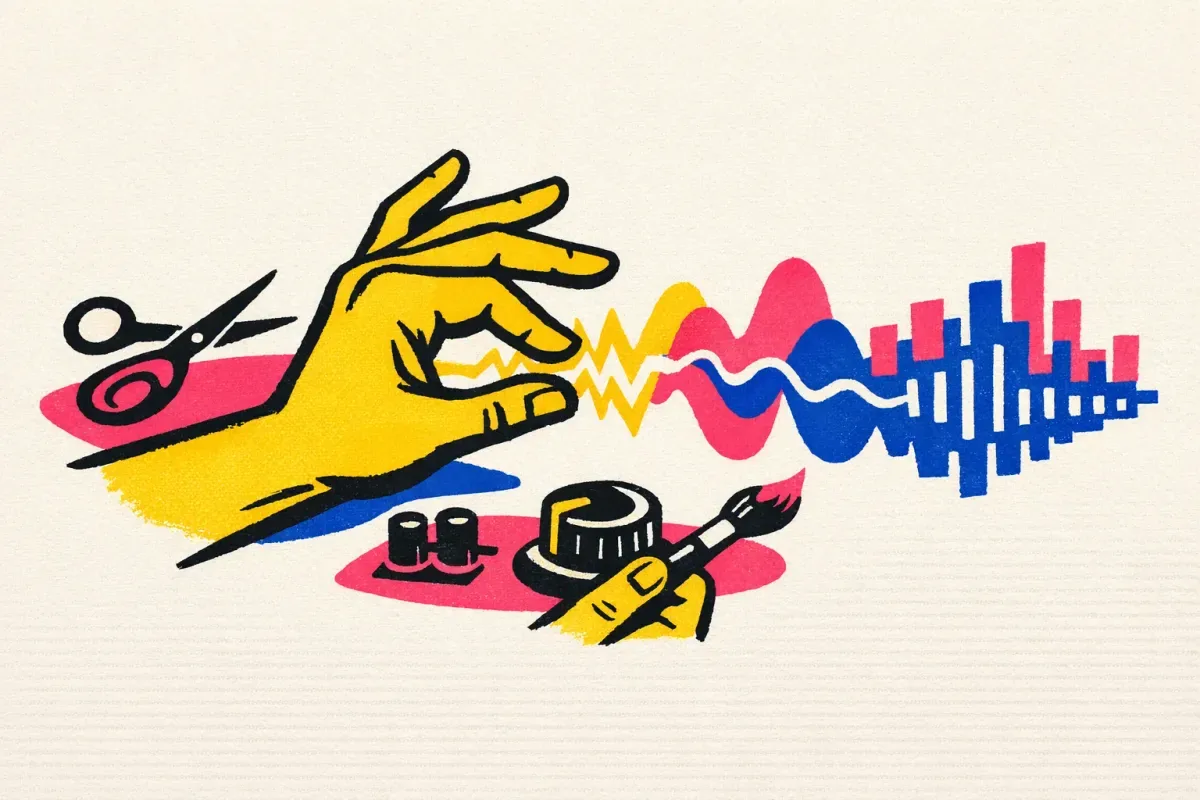
Suno now lets users change a single section without rebuilding the whole song, swap out one line of lyrics, combine elements from multiple sources, isolate an instrument from a sample and build on it, or use text, audio, images and video as a starting point.
It starts to look less like a machine that delivers a finished song and more like a strange new studio instrument.
And that is where I think the debate about AI music becomes interesting.
Because if someone spends three hours changing the arrangement, rewriting the lyrics, discarding 40 generations, moving the chorus, isolating the guitar and building a new rhythm underneath it, it is hard to simply point at the result and say: “The machine made it.”
But it is just as hard to pretend the model is merely another guitar pedal.
It has already learned from music other people created.
Suno says v6 was developed with licensed data and in collaboration with, among others, Warner Music Group, BMG and Believe, and that the new model was not trained on the same data as earlier Suno models. That is a fairly significant change of course for a company that has been at the centre of one of the music industry’s biggest conflicts over AI training.
But the conflict has not gone away.
Sony Music and Universal Music Group still have copyright cases against Suno and filed yet another complaint about v6 in September. Among other things, they claim the new model still builds on output from earlier models and therefore cannot simply be seen as a clean slate. Suno rejects the broader allegations of unlawful use and maintains that its tools are built to create new music.
In addition, musicians such as Jason Isbell and David Lowery have sued Suno, claiming the platform can imitate artists’ musical identity without consent. Suno also disputes those claims.
It is tempting to make the whole debate morally very simple.
Humans good. AI bad.
That just does not hold up for very long.
A musician can use AI curiously, precisely and creatively. At the same time, a completely human-made pop single can be the result of 14 songwriters, a sample, pitch correction, vocal processing and a marketing meeting where no one in the room has the same name as the artist on the cover.
Authenticity has never been as pure as the music industry likes to sell it.
But AI makes the difference between illusion and information more important.
I do not necessarily need to dislike hearing an AI-created song. I just want to know what I am listening to.
If the voice does not belong to a human being, that matters. If the lyrics were generated, that matters. If a real artist used AI as a tool in a longer creative process, that matters too. Not because one of those answers automatically makes the song good or bad, but because authorship still matters to the way we experience art.
Spotify is therefore onto something with its labels and credits.
The problem is simply that we are still trying to solve a very fluid question with small fixed labels.
Conclusion without a conclusion
Perhaps the most interesting thing about AI music is no longer whether a computer “can make a song.” It can. The question is where the human begins, where the model ends, and whether we as listeners are allowed to see the difference.
A small AI label can tell us that the artist in the picture does not exist. The harder, and far more important, task is to tell us who was actually present when the music came into being.
En stjerne
To stjerner
Tre stjerner
Fire stjerner
Fem stjerner
Seks stjerner