I’m not sure what’s more absurd: that I watched a K-pop anime musical twice in one week — or that I loved it. KPop Demon Hunters may be the best film I’ve seen in 2025, and it feels like a confession I should be making under a pseudonym. I went in with the same expectation you have when a friend insists you “just have to watch a YouTube video.” I came out with tears in my eyes and tinnitus from trap beats.
One star
Two stars
Three stars
Four stars
Five stars
Disclaimer: Apropos Magazine received access or a review copy. As always, we share our own impressions — unfiltered.
Six stars
I should start with a confession: I’m not the kind of person who wears bunny ears or collects plastic figures with huge eyes. I’ve always thought adults who watch anime should go for a walk in the woods. The same goes for people who treat Danish rap as art, or techno as religion. But we’re all different, and KPop Demon Hunters hit me in a place I thought I was immune: right in the pop-cultural solar plexus.
The film is produced by Sony Pictures Animation — the same people who gave us Spider-Man: Into the Spider-Verse — and released by Netflix, after Disney sold the rights for 20 million dollars and dropped the theatrical release. Which presumably means they didn’t believe in the project. Oh boy, were they wrong. At a time when every streaming service is competing to see who can make the most depressing true-crime series, it felt like a shot of vitamins to watch something colourful, theatrical and musical — so overwhelming that you feel like calling Max Martin to ask whether he’s doing okay.
The story? It sounds insane, but it works. Three K-pop superstars fight the demons of the underworld using their voices, which create a protective barrier — “the honmon.” It’s the kind of sentence you’d normally dismiss with a snort, but here it lands. It’s so shameless, so bombastic, that you surrender to it.
And then there’s the music. The soundtrack is simply called KPop Demon Hunters (Soundtrack from the Netflix Film) — nine original tracks written and produced by some of the biggest names in the business: Teddy Park (Blackpink, BIGBANG), 24, Ido, Jenna Andrews, Mark Sonnenblick and Ian Eisendrath. The latter is a music producer from the Broadway world, which explains why the songs actually have melodies and dramatic arcs instead of just sounding like TikTok samples. The track “Golden,” written by Ejae and Sonnenblick, went straight onto the Billboard Hot 100 — the first soundtrack song by a fictional K-pop group ever to do so. It’s not just catchy; it’s superhumanly produced pop wrapped in anime aesthetics, as if Studio Ghibli had gone through an EDM phase.
Visually, the film is an explosion. The animation is hand-drawn and digital at once, with a pace that makes Spider-Verse look like a silent film. The colours pulse in time with the music; every cut feels like a beat. It almost gives you a headache — but in the way that makes you want to watch it again afterwards. And then there are the tiny details: reflections in shards of glass, neon light, movements in the choreography landing with second-perfect precision. It’s like being trapped inside a music video where everything suddenly matters.
The voices do the rest. Arden Cho, May Hong and Ji-young Yoo voice the three leads, and they perform with a sincerity that makes you forget the whole thing is about demons and dancing. It feels like a musical in which the characters sing because they simply can’t help themselves.
Of course, there are moments when it becomes too much. When the animation hyperventilates and the plot throws another magic orb at your head while you’re still trying to understand what the “honmon barrier” actually is. But that’s precisely the charm: it takes itself seriously enough that you don’t have to. It’s a bit like riding a roller coaster at Tivoli on LSD — through a rainbow — to 140 BPM K-pop with trap and four-on-the-floor pounding underneath.
I thought I’d leave with tinnitus. Instead, I left with hope. KPop Demon Hunters is not just pop and glitter; it’s also about identity, fear and finding your voice — literally. When the characters use song as a weapon, it doesn’t feel like a gimmick, but like a statement.
There’s a scene halfway through where the protagonist Atsu confronts her own demonic double. The music cuts out, the camera slowly pushes in, and you can hear her breathing before the beat explodes back in. It’s pop, but it’s also art.
What I love is that the film doesn’t try to make K-pop cool for those of us who normally listen to The Weeknd. It insists that K-pop already is cool — we’ve just been too slow to notice.
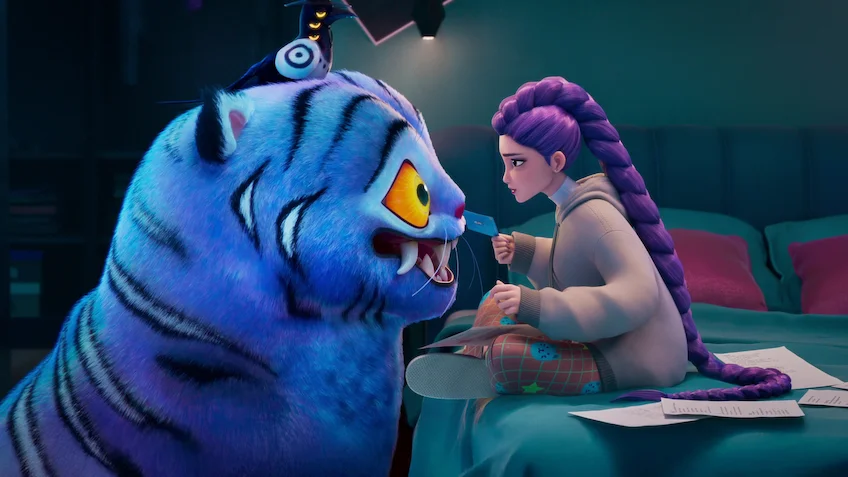
It’s hard to describe the feeling afterwards. It’s like having watched Spider-Verse, Kill Bill and Frozen all at once, edited by a DJ who’s had too much matcha. I don’t know what I expected, but I know I got more than I thought I would.
There are probably people who will dismiss the film as silly. Fine. People said the same about Grease, The Rocky Horror Picture Show and everything else that later became cult. KPop Demon Hunters may end up as one of those works people will cite in the future as a turning point — where East and West, pop and anime, were blended in a way that actually worked.
And yes, I know how ridiculous it sounds when I write that, but it feels honest: I don’t think I’ve seen anything as bold, beautiful and absurd at the same time this year.
In reality…
In reality, KPop Demon Hunters isn’t about demons or pop music. It’s about daring to take yourself seriously in a world that laughs at it. About creating something extravagantly beautiful even when nobody asked for it. And maybe that’s why I can’t let it go.
En stjerne
To stjerner
Tre stjerner
Fire stjerner
Fem stjerner
Seks stjerner