There are works you don’t just revisit. You enter them again, the way you step into a room where someone once said something important. Another Brick in the Wall, Part 5 at Royal Arena is that kind of experience. Big, dark, precise, and carried by music that still has dust, anger, and human loneliness clinging to it.
One star
Two stars
Three stars
Four stars
Five stars
Disclaimer: Apropos Magazine received access or a review copy. As always, we share our own impressions — unfiltered.
Six stars
The first thing you feel is the scale. Not just the physical size, though Royal Arena certainly does its part. The space is wide, tall, and filled with that particular anticipation that arises when an audience knows it is about to meet something it already has a relationship with. Pink Floyd’s The Wall is no longer just an album. It has become part of culture’s back wall. Something many have heard, inherited, misunderstood, rediscovered, or stood in a kitchen singing along to without quite knowing why it still felt so sad.
Another Brick in the Wall, Part 5 steps into that legacy with respect. Not from a distance, but from within. The production does not try to make the work clever, modern, or unnecessarily explanatory. It lets the darkness stay dark. It lets the isolation stand. It lets the old story of Pink, the rock star, the child, the human being behind the wall, unfold as something that still carries a strange, familiar force.
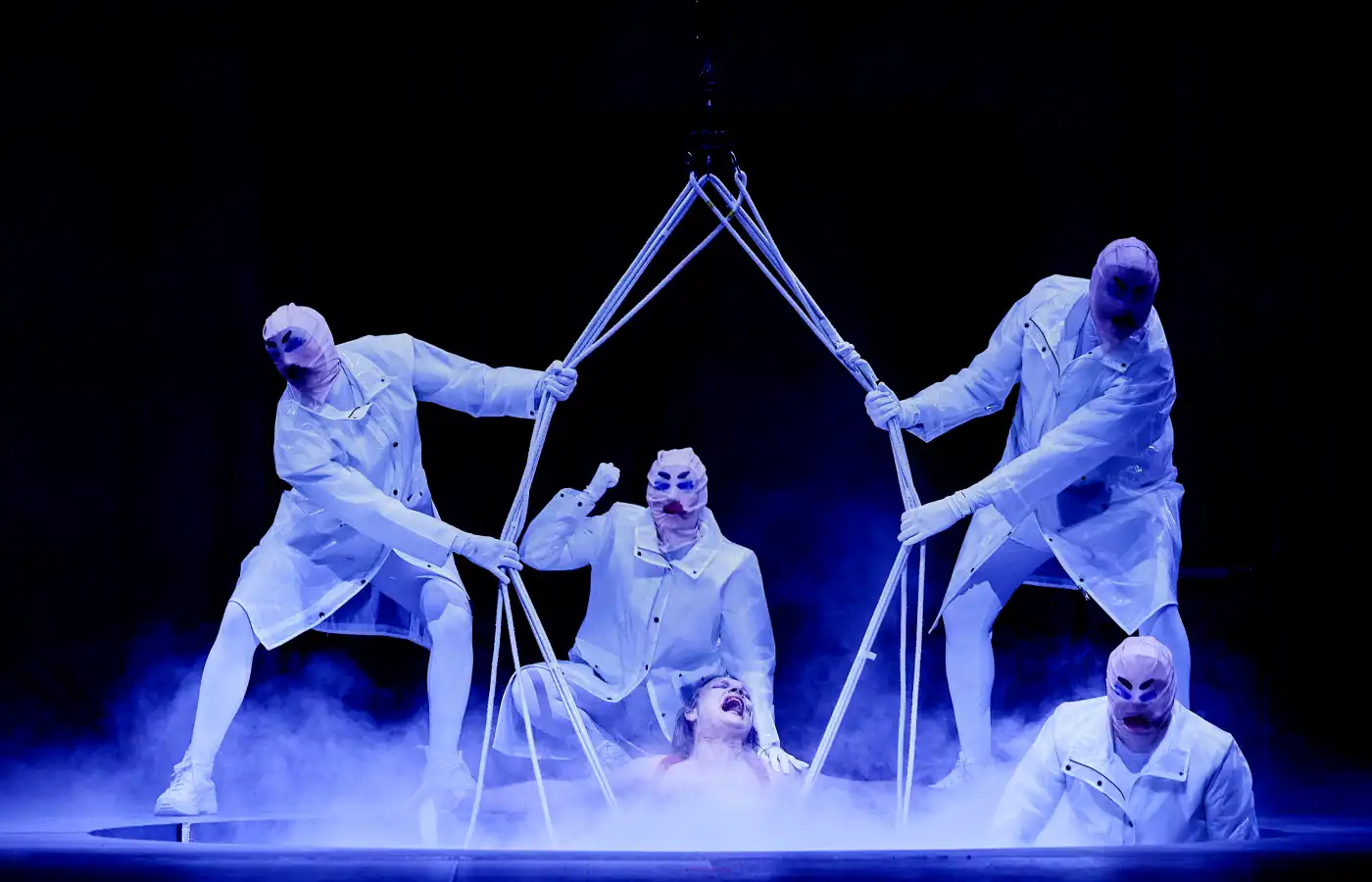
The staging is impressive. Not in that empty, expensive way where you can feel the budget more than the idea, but as a complete theatrical universe, where dancers, acrobats, light, and bodies all work in the same direction. There are movements in the show that do not merely illustrate the music, but almost breathe with it. The bodies become fragments of memory. Of unease. Of pressure. Of the small mechanisms that build a person up and slowly lock them away.

This is where the production is strongest. When it does not simply show the breakdown, but lets us feel how it begins. Not as one great dramatic event, but as repetition. As layers. As yet another brick in the wall. You sit there watching a story about isolation, and yet it never feels entirely distant. Perhaps because isolation rarely looks dramatic from the inside. Perhaps it just looks like a man who can no longer hear the others.
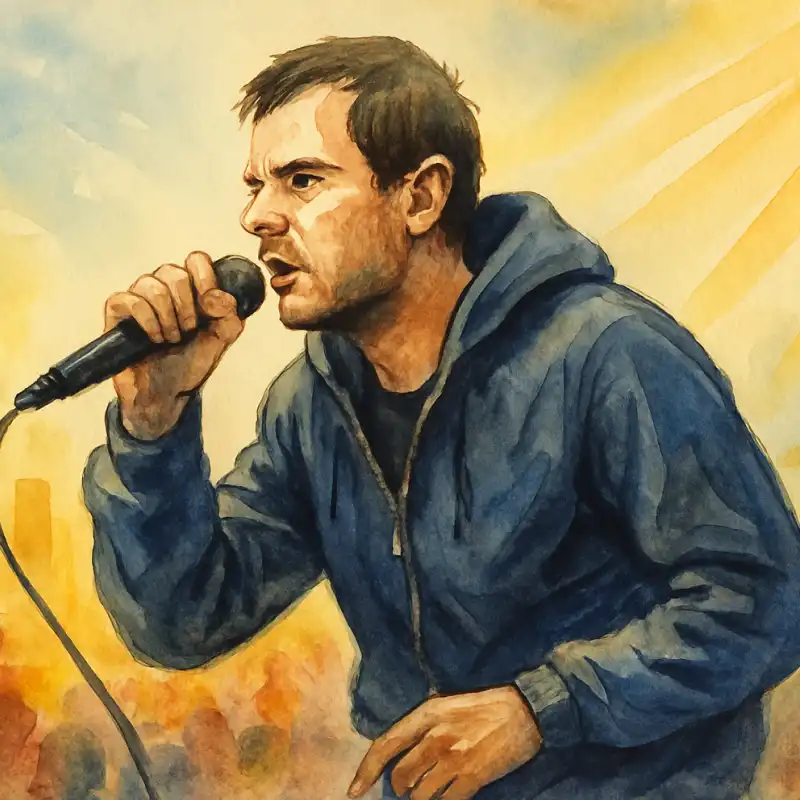
Jesper Binzer as Pink is one of the production’s most interesting choices. He does not enter as a classic musical lead. Fortunately. He brings something else with him. A roughness. An experience. A body that knows what it is like to stand in front of many people and still be alone in its own face. It suits the role. He does not play Pink as a polished theatre figure, but as a human being with wear in his voice and resistance in his body.
There are moments when you sense that Binzer is still finding his way into the role as an actor. That hardly matters. On the contrary, it gives the character something alive. He does not seem polished. He seems present. And in a production that is, in places, so technically precise and visually controlled, it is a strength that the lead still has something unruly in him. You believe him because he does not look freshly washed.
The music is, of course, the great carrier. It almost feels banal to write that, but it is also true. It still stands with a force that much newer music secretly envies. The songs have that rare quality of being both monumental and vulnerable. They can fill an arena and still feel like something being said into a wall. That is where the work remains relevant. Not because the world needs more stories about male rock mythology, but because the feeling of alienation has not become any smaller. It has just gotten better screens.
The production succeeds because it understands that The Wall is not only about spectacle. It is about what happens when a human being slowly loses connection to others. And precisely for that reason, the arena format works surprisingly well. Royal Arena could easily have made the work bigger, but more distant. Instead, the space is used to intensify the loneliness. There is something almost uncomfortably beautiful about sitting among thousands of people and watching one person disappear into himself.
There are a few places where the evening could have had even more physical force. The sound could have been more palpable from the beginning. In a production like this, you should not only hear the bass. You should feel it in your chest before you have time to think about whether you feel it. Only toward the end does that dimension really emerge, and when it does, the body understands what the ears have long since understood.
The same goes for Binzer’s voice, which in a few places could have stood out more clearly in the soundscape. Not because he needs to overpower the universe, but because the character’s inner collapse demands that we follow him closely. When the voice comes forward, the production feels more dangerous. When it slips a little back, it becomes prettier than it needs to be. And The Wall should be allowed to bite.
But that is not criticism that topples the experience. It is more the kind of longing that arises when something is already very close to being great. You do not wish for a different production. You just wish it would dare to let go a little more now and then. More unrest. More wildness. More edge. Not because the staging lacks courage, but because the work’s rebellion still feels like something that ought to scratch a little deeper.
For Another Brick in the Wall, Part 5 is an unusually strong stage production. One of those rare large-scale arena shows where the format does not swallow the story, but actually gives it more air. It is ambitious without losing its respect for the material. It is big without becoming hollow. And it gives Jesper Binzer a role in which his rock history is not just a casting trick, but part of the production’s substance. He knows something about the stage. He knows something about the noise. And perhaps he also knows something about the silence afterward.
In truth, that is what stays with you. Not only the big images or the familiar songs, but the sense of a work that can still gather many people around a story about loneliness. That is the paradox, and it is beautiful. Royal Arena becomes a large room for something very inward. The production does not insist on explaining the pain. It puts it out in front of us. And that is enough.
En stjerne
To stjerner
Tre stjerner
Fire stjerner
Fem stjerner
Seks stjerner