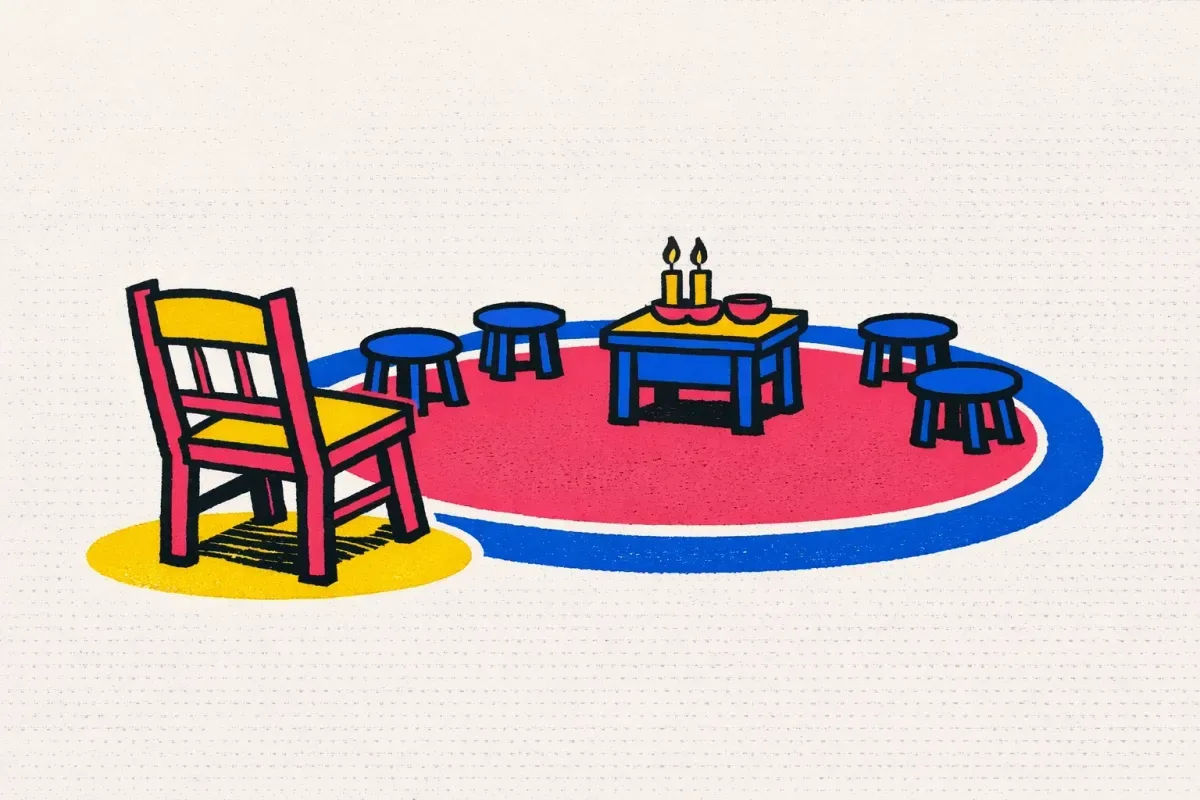
It’s easy to call yourself inclusive when no one has asked you to move the furniture yet. At Enghave Church, the question becomes more concrete: Who gets to shape a religious community, and what happens when the answer is visible from the street?
One star
Two stars
Three stars
Four stars
Five stars
Disclaimer: Apropos Magazine received access or a review copy. As always, we share our own impressions — unfiltered.
Six stars
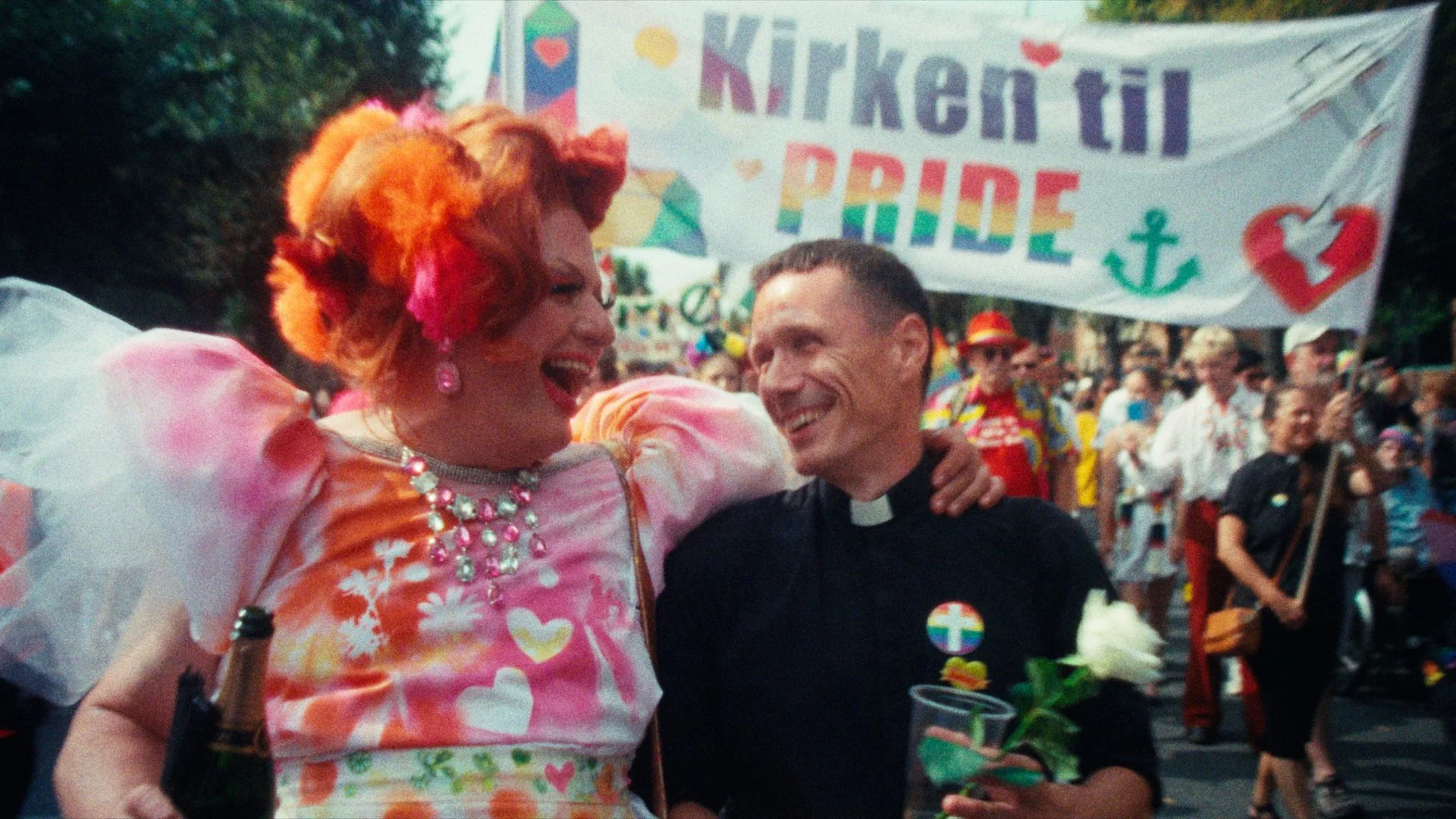
My reading of All of God’s Colours is that the documentary examines inclusivity as a practical distribution of power. Enghave Church does not stop at declaring that everyone is welcome. The church holds services for the Danish HIV community and organises Children’s Pride for rainbow families. These are not just symbols. They are choices about programming, audience and public identity. A community changes when people other than its traditional core are allowed to decide what happens inside it.
That is also why resistance becomes part of the film’s material. The Children’s Pride service has been criticised by conservative Christians and right-wing political voices. Among the actors mentioned in connection with the confrontations are Dansk Regnbueråd, Rasmus Paludan and Rasmus Munch Søndergård. The film follows the church through a year in which such conflicts do not remain abstract culture-war theatre, but land in a concrete place with a concrete calendar.
That has a significance that reaches beyond Enghave. A value can survive for a long time as a neat formulation. It becomes far more vulnerable once it has an altar, a children’s service and people who no longer want to be content with being tolerated guests. The church makes belonging visible, and visibility is rarely free. It invites both recognition and the opposite: the feeling among others that a space has been taken from them. The latter is not necessarily an argument against the church. It is a description of the fact that community is always about space and priorities.
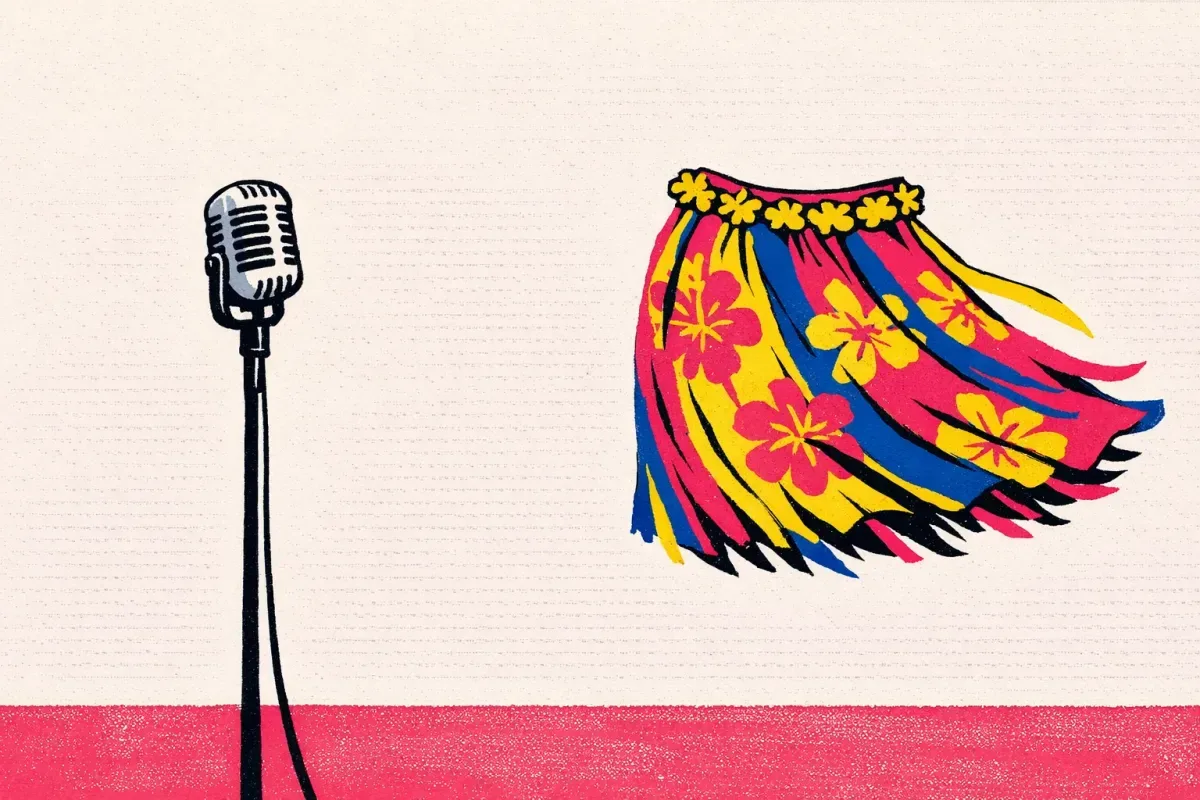
Bo, the film’s church caretaker, appears both under his legal name and as the drag persona Ramona Macho. According to the coverage, he speaks about a childhood in which the feminine side of him, and his interest in singing and dancing, had to be kept in check. In one scene, he says his father reacted dismissively when Bo, at the age of ten, performed in a Hawaiian skirt.
The Hawaiian costume is almost comical in its innocence. That is precisely why it becomes such a sharp detail. A child puts on a dance number, and an adult reads it as something that must be stopped. Here lies one of the documentary’s most precise conflicts: Who decides when play becomes wrong, and who gets to perform without first having to explain themselves?
In that context, Ramona Macho can be read as a public space for what was previously held back. But the persona is not fairy dust that dissolves every old wound. The film shows Bo moving between different ways of being visible. His mother, Gurli, is described as proud and fascinated by his ability to move between the two personas. It can be read as an image of free self-creation. It can also contain a restlessness: Is the shift an expression of freedom, or a social technique one learns because the world still cannot hold the whole self all at once?
The film follows Ramona to a performance at Bøssehuset in Christiania and to communal singing during Pride at City Hall Square. These places show that belonging does not only arise in the institution that opens the door. It is also created through scenes, rituals and repetition. Singing together is a small, but demanding, form of collectivity. You have to blend your voice with others and accept that the community does not sound exactly the same.
A fair counterargument is that Enghave Church is a special place. The documentary therefore cannot be used as proof that Danish church life in general has become inclusive. On the contrary, a priest in the film says that among young confirmation boys he experiences growing scepticism toward queer communities, which points to an uneven development.
All of God’s Colours does not offer a simple recipe for acceptance. It shows something more difficult: A community only truly includes when it accepts having its sound, its rituals and its idea of who naturally belongs changed. The decisive question is therefore not whether the door is open. It is who is still expected to leave part of themselves behind before they walk in.
En stjerne
To stjerner
Tre stjerner
Fire stjerner
Fem stjerner
Seks stjerner