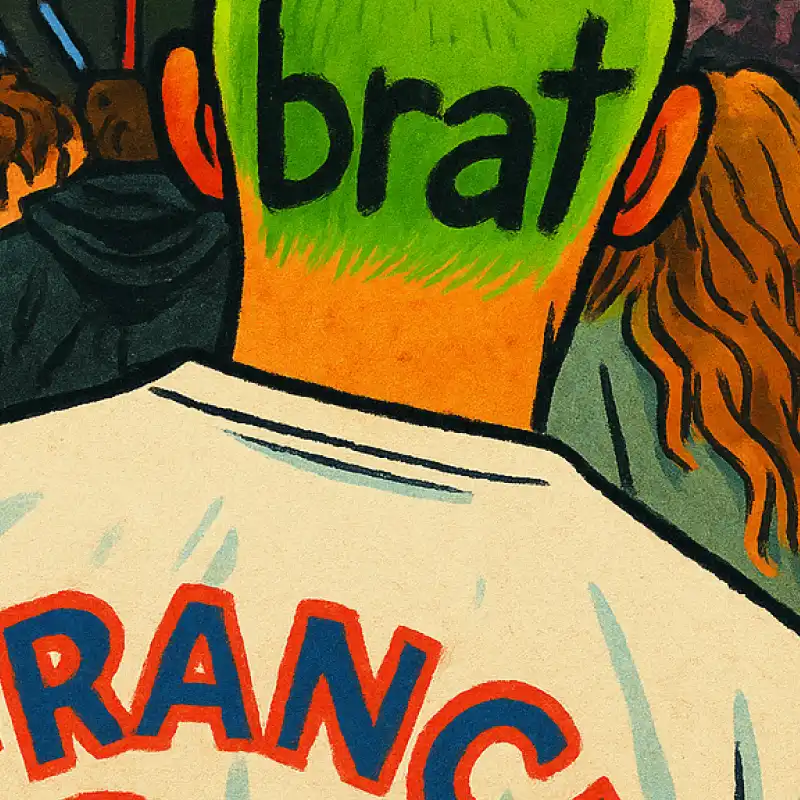
What do Catholic guilt, the dance floor at Tivoli, and the Danish People’s Party have in common? Morten Messerschmidt has written Showbizz — and it’s far more entertaining than it has any right to be.
One star
Two stars
Three stars
Four stars
Five stars
Disclaimer: Apropos Magazine received access or a review copy. As always, we share our own impressions — unfiltered.
Six stars
If you think this is yet another political memoir, you’re wrong. And if you don’t think so, you’re probably right. Showbizz is not an apology dressed up as recollection — it’s a performance dressed up as a man. With the charm of theatre, the gravity of church, and the mirror trick of the press, Morten Messerschmidt tries to make one thing clear: he would rather be loved as a character than understood as a person.
There’s something almost Wes Anderson-esque about it. Morten Messerschmidt, with his perfect side parting and the perpetual sense that he has taken the stage in trousers just a little too tight, has written an autobiography. Or no — this is not a classic politician’s account. This is Showbizz. The title alone makes it clear that we should not expect footnotes and finance bills, but rather a kind of operetta about Messerschmidt’s life and suffering — in Danish politics, in the pillory of the press, and in the shadows of faith.
The book is composed in three acts: faith, theatre, and speech. The first act runs on Messerschmidt’s Catholic conviction. He goes to church not only because it’s a Sunday habit, but because he means it. That part is surprisingly honest. There’s something touching about how unstrategic it feels — as if faith is not a tool, but a refuge. This is not religious marketing, but a man who, in all his contradictions, is searching for something higher, perhaps because no one on earth quite wants to understand him.
The second act is the public performance: Messerschmidt as media figure, as a mockingly edited satire clip, as material for tabloids and talk shows. He takes us behind the scenes — quite literally — in Tivoli, on DR’s dance floor, in court. Here he balances somewhere between self-pity and self-awareness, but he has his pen with him. And it’s sharp, precise, polemical. If you thought he would lie down and take it, you don’t know the man. He still needs an audience. Even if they don’t clap.
He writes the way he speaks: solemn and theatrical, but with a twinkle in his eye. You’re left wondering how much of it is real, and how much is performance. But maybe that’s the point: Morten Messerschmidt cannot be separated from the image he has built for himself. He is his own character. Not a prototype for a new Danish conservatism, but someone mixing Grundtvig with the Eurovision Song Contest. And that is actually quite unique.
It all culminates in the third act, where we approach the collapse of the Danish People’s Party, the crisis-ridden brand of Danishness, and Messerschmidt’s own legal battles. He is not objective. He knows that. But he has timing. And he knows how to write a sentence so it sounds like something from an editorial in Kristeligt Dagblad and a joke in Tæt på sandheden — at the same time. It is well written. It is unbelievably calculated. It is entertaining. And irritatingly self-assured.
This is not a book that tries to make you understand politics. It tries to make you understand why he is still here. Why he still gets up every morning and ties his tie — and why we still bother to watch. And when you close the book, you don’t come away with a deeper understanding of society. You come away with the feeling of having read a good script. One that was ready for DR’s head of drama, but ended up at Gyldendal.
—
Reflection
There are plenty of reasons to hate Showbizz. It is self-staging, ideologically rigid, and manipulative in the way only a charismatic politician can be. But it is also entertaining. It is precise. And it is honest enough that you have to take your hat off to it — even if you would never vote for him. Perhaps especially for that reason.
4 out of 5 stars (… and a quiet round of applause behind closed curtains.)
En stjerne
To stjerner
Tre stjerner
Fire stjerner
Fem stjerner
Seks stjerner