Nintendo has had sport in its blood since the NES days, and Mario has long been the company’s most dependable multi-athlete. Baseball, golf, football, the Olympics — and perhaps most naturally of all: tennis. The aristocratic discipline meets an Italian plumber in red, and somehow, miraculously, it still works. The question is not whether Mario can serve. The question is whether you can return it.
One star
Two stars
Three stars
Four stars
Five stars
Disclaimer: Apropos Magazine received access or a review copy. As always, we share our own impressions — unfiltered.
Six stars
This article is a primer and a look ahead to the release on 12 February.
Nintendo operates in a parallel reality where sport is not about realism, but temperament. Where physics is flexible, and where a fire flower can be just as legitimate a strategy as perfect footwork. Mario Tennis adds another chapter to that tradition — and does so with a confidence that borders on the carefree.
This time, 38 characters from the Mushroom Kingdom step onto the court. From the iconic front-runners to the more obscure fan favourites, each with their own strengths, weaknesses and play styles. This is not just cosmetic variety. Nintendo works mechanically. A heavy character moves differently. A technical character hits differently. Balance is part of the architecture.
At the same time, 30 new rackets with special abilities are introduced, inspired by classic power-ups. That changes the dynamic significantly. It is no longer just about timing and reaction — but about understanding the system. Which racket extends your shots? Which one boosts your spin? Which one creates that little bit of chaos that forces your opponent out of rhythm?
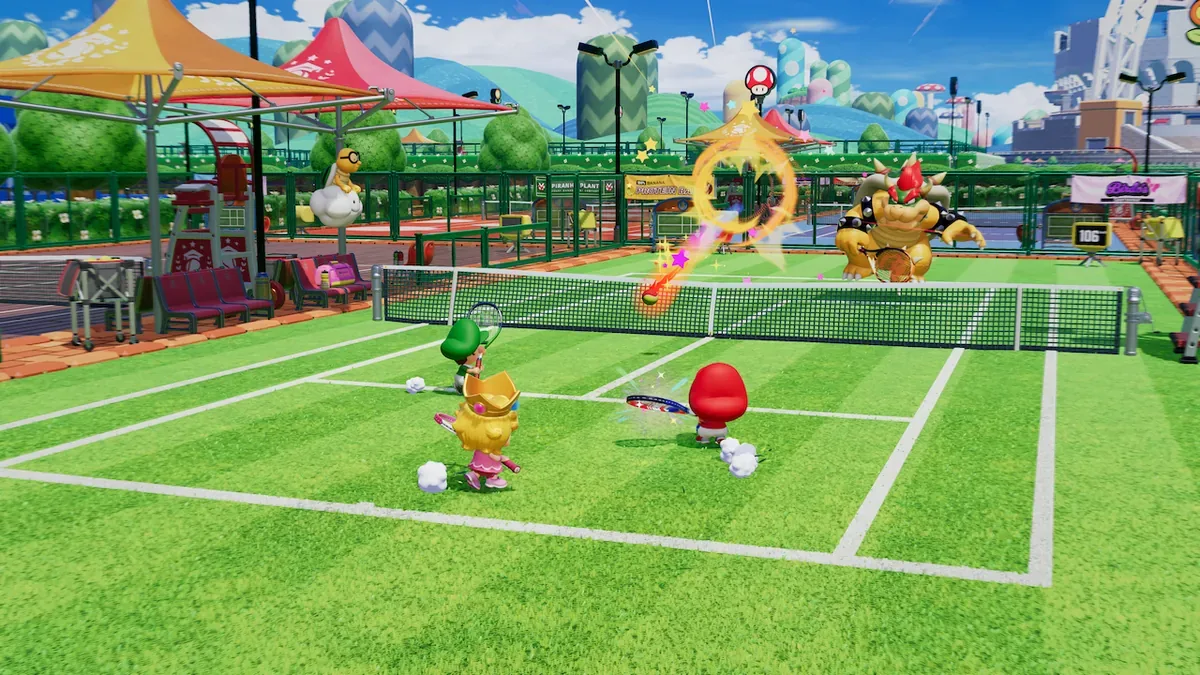
Mario Tennis has always lived in the tension between accessibility and depth. You can pick up a Joy-Con and be playing within seconds. Serve, return, smash. But if you want to dominate, it takes more. Timing. Anticipation. Psychological finesse. Drawing your opponent wide. Varying the pace. Reading the game before it happens.
There is something almost brutal about it once it turns serious. The online side is going to be merciless. The colourful look and playful animations do not hide the fact that frame windows, precision and millisecond decision-making will decide the matches. What begins as a cheerful sofa duel can quickly turn into a technical contest for honour.

Adventure Mode is classic Nintendo in tone. Mario and company are turned into babies and must — quite literally — learn to master tennis before they can crawl. It is absurd. It is funny. And it works. Beneath the childlike layer lies a structured progression that gradually introduces mechanics and builds competence. Nintendo rarely explains with long tutorials. They design situations in which you understand it for yourself.
Trial Towers mode turns up the precision demands. Here, your control and reaction speed are tested in challenge-based sequences where the margin for error is minimal. This is where the game’s technical side comes through most clearly. For those who want more than just a cosy match, this is where Mario Tennis reveals its true level of ambition.

Joy-Con motion controls make it possible to physically swing the racket. It is not necessarily the most precise way to play — but it is fun. It invites laughter, upper bodies in motion, the chaos that arises when three people stand too close in front of a TV and try to return an unexpected smash. GameShare support makes it easy to gather people locally. Nintendo holds on to the idea of shared space. Same screen. Same laughter.
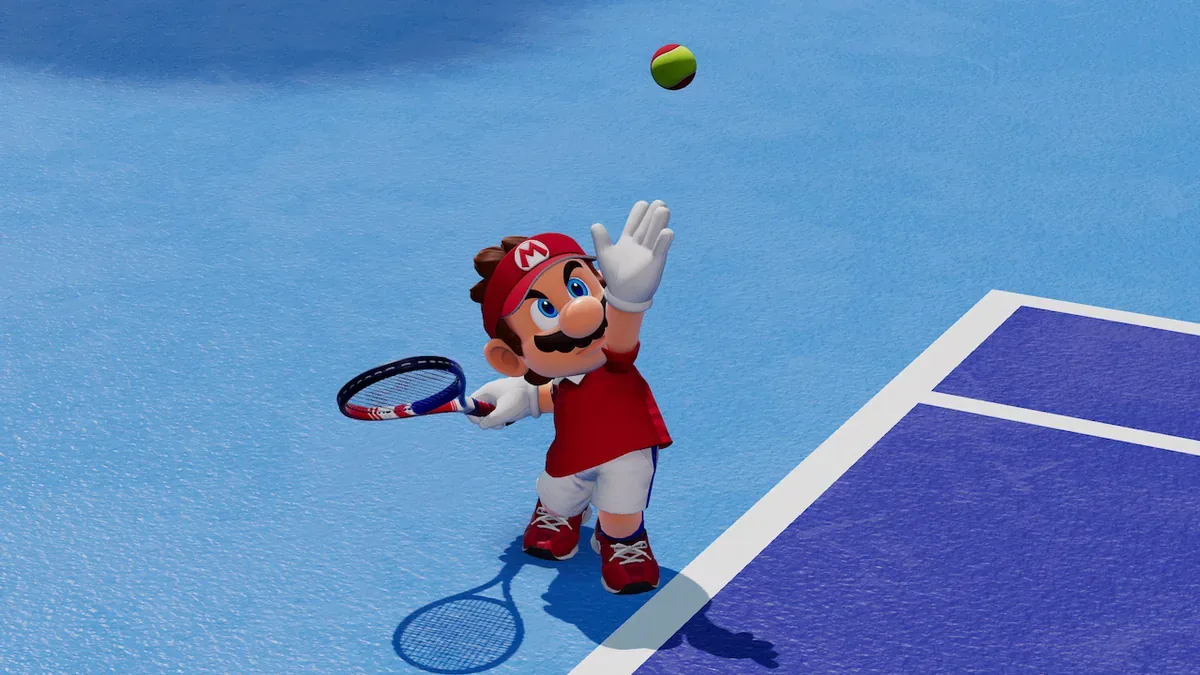
Visually, it is exactly what you would expect: colourful, polished, energetic. The courts vibrate with life. The effects are exaggerated, but controlled. There is constant movement. Constant stimulation. This is not minimalism — it is maximalism at child height, with adult system design.
What makes Mario Tennis most interesting, though, is not the number of characters or modes. It is the balance. Nintendo is once again trying to bridge the inclusive and the competitive. It is a game that can work as Friday-night entertainment — but one that can also swallow entire evenings if you start chasing perfection.
In a games industry constantly chasing hyperrealism and simulation, Mario Tennis stands as a reminder of something else. Sport as expression. Sport as play. Sport as system — without being trapped by the rules of reality.
The plumber with the serve is back on court.
The only question is how hard you dare to hit back.
En stjerne
To stjerner
Tre stjerner
Fire stjerner
Fem stjerner
Seks stjerner